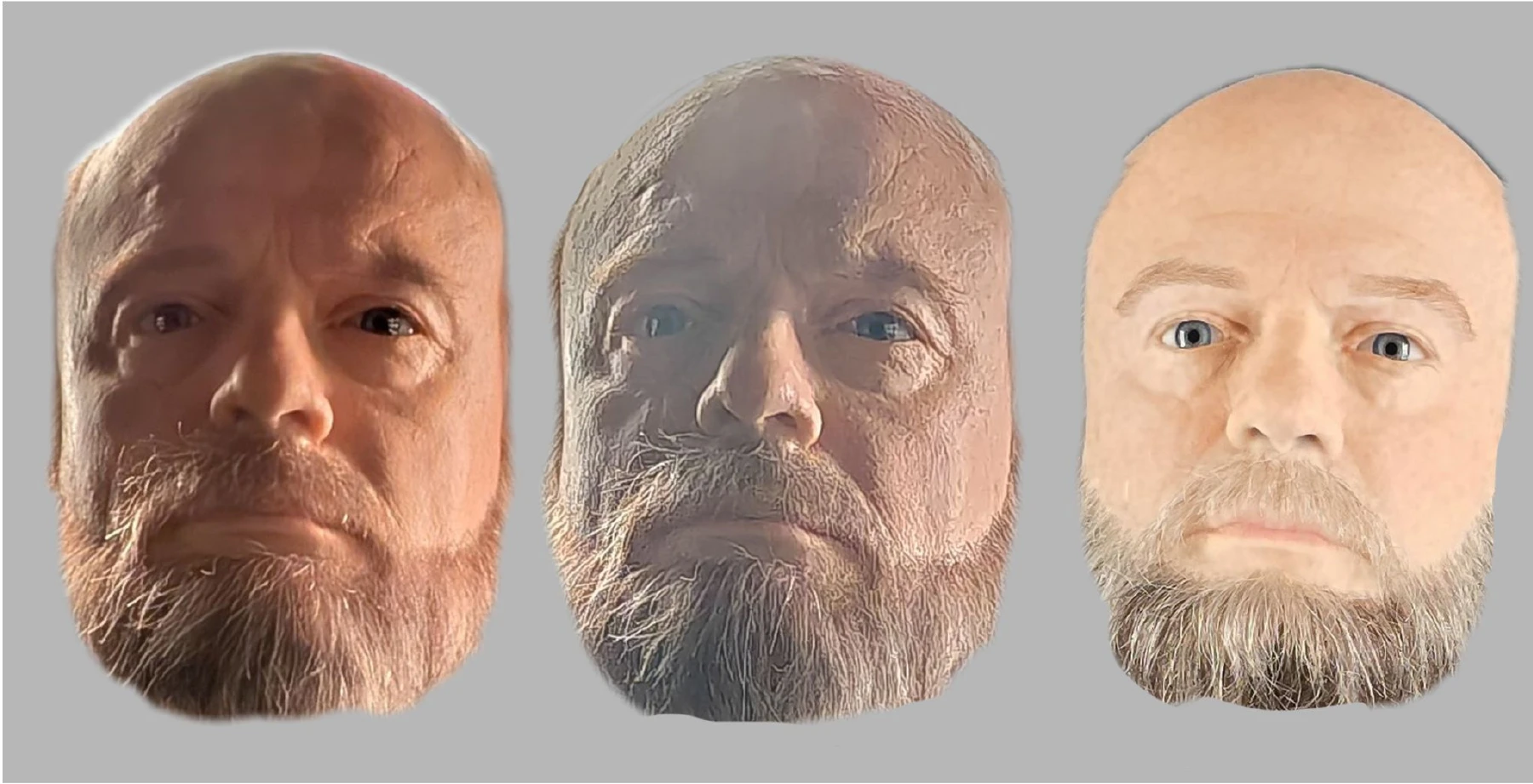
ONE FACE. DIFFERENT RENDERINGS.Examples from the paper
01 Tonal separation02 Fine skin detail03 Eye definition
The same face can look remarkably different across smartphones and lighting. We disentangle its contrast into three interpretable perceptual components.
THE IDEA
Face contrast is more than a single number.
Overall tonal separation, eye definition, and fine skin detail contribute differently to how a portrait looks. We measure each component and validate it against human perception.
Abstract
The quality of smartphone portrait photography has become increasingly important to both manufacturers and users. Recent devices use complex computational pipelines to improve facial rendering under varied lighting. These pipelines vary widely across manufacturers, so the same portrait can look noticeably different across smartphones. These differences affect multiple aspects of facial appearance, making perceptual preference difficult to characterize with a single measure. To address this, we propose an interpretable framework that decomposes face contrast into three components: overall facial tonal separation, eye‑region contrast, and micro‑contrast of fine skin details.
We formulate dedicated metrics for each component and validate them via pairwise human judgments, demonstrating that our approach correlates more closely with human contrast perception than traditional contrast measures. To support this analysis, we introduce a realistic mannequin‑based dataset designed for systematic facial contrast evaluation, comprising 508 full‑resolution captures from 29 smartphones under diverse lighting, with region‑specific masks and extensive pairwise perceptual annotations. As a downstream analysis, we show that combining the three component‑wise metrics provides a meaningful basis for modeling balanced facial contrast preference in a controlled setting, and we present a preliminary evaluation on a smaller real‑portrait dataset indicating that insights derived from the mannequin study can extend to real images. Our work provides a controlled first step toward defining and evaluating face contrast in portrait imaging.
01 / METHOD
What do we mean by face contrast?
We define three components of contrast and study how their balance relates to portrait preference.
CONTRAST AMOUNT · FACE
Overall contrast
The global tonal separation across the face: how clearly bright and dark regions are separated. It describes facial shading and the transitions that give the face depth.
How strongly are light and shadow separated across the face?
CONTRAST AMOUNT · EYES
Eye contrast
The local lightness separation within the eye region, between dark structures such as the pupil and brighter structures such as the sclera. It describes how distinctly these structures appear.
How clearly do dark and bright structures stand apart within the eyes?
CONTRAST AMOUNT · SKIN DETAIL
Micro-contrast
The visibility of fine facial details, such as skin pores and small local structures. It describes how strongly fine skin texture is rendered in the final portrait.
How visible and pronounced are the fine details of the skin?
PERCEPTUAL PREFERENCE · THE THREE COMPONENTS TOGETHER
Balanced contrast
The perceived harmony among overall tonal separation, eye definition, and fine-detail visibility: whether they form a natural and visually pleasing balance.
Which portrait has the more pleasing balance of facial contrast?
More contrast is not always better. Balanced contrast is a separate preference judgment over the three components, rather than a fourth measure of contrast amount.
How we measure the three components
All three measures use the L* (lightness) channel of CIELAB, normalized to [0, 1] and denoted by L. This separates tonal variation from chromatic variation. Select a component to explore its computation.
FACE REGION
The structure of light and shadow.
Overall contrast captures tonal transitions across the face. Local lightness variation is normalized by the local mean and pooled over five spatial scales, from fine shading to broader facial structure.
Here, μr and σr are the local mean and standard deviation of L, the normalized CIELAB L* channel. The response is averaged over the face and across window sizes 16, 32, 64, 128, and 256.
COMPUTATION AT A GLANCE
Five window sizes, one face-wide measure.
16 × 1632 × 3264 × 64128 × 128256 × 256
Measure local tonal variationNormalize local standard deviation by local mean lightness.
Pool within the faceAverage the response over the face mask at each scale.
Combine the scalesAverage the five scale-wise values to obtain overall contrast.
EYE REGION
Small region. Strong visual impact.
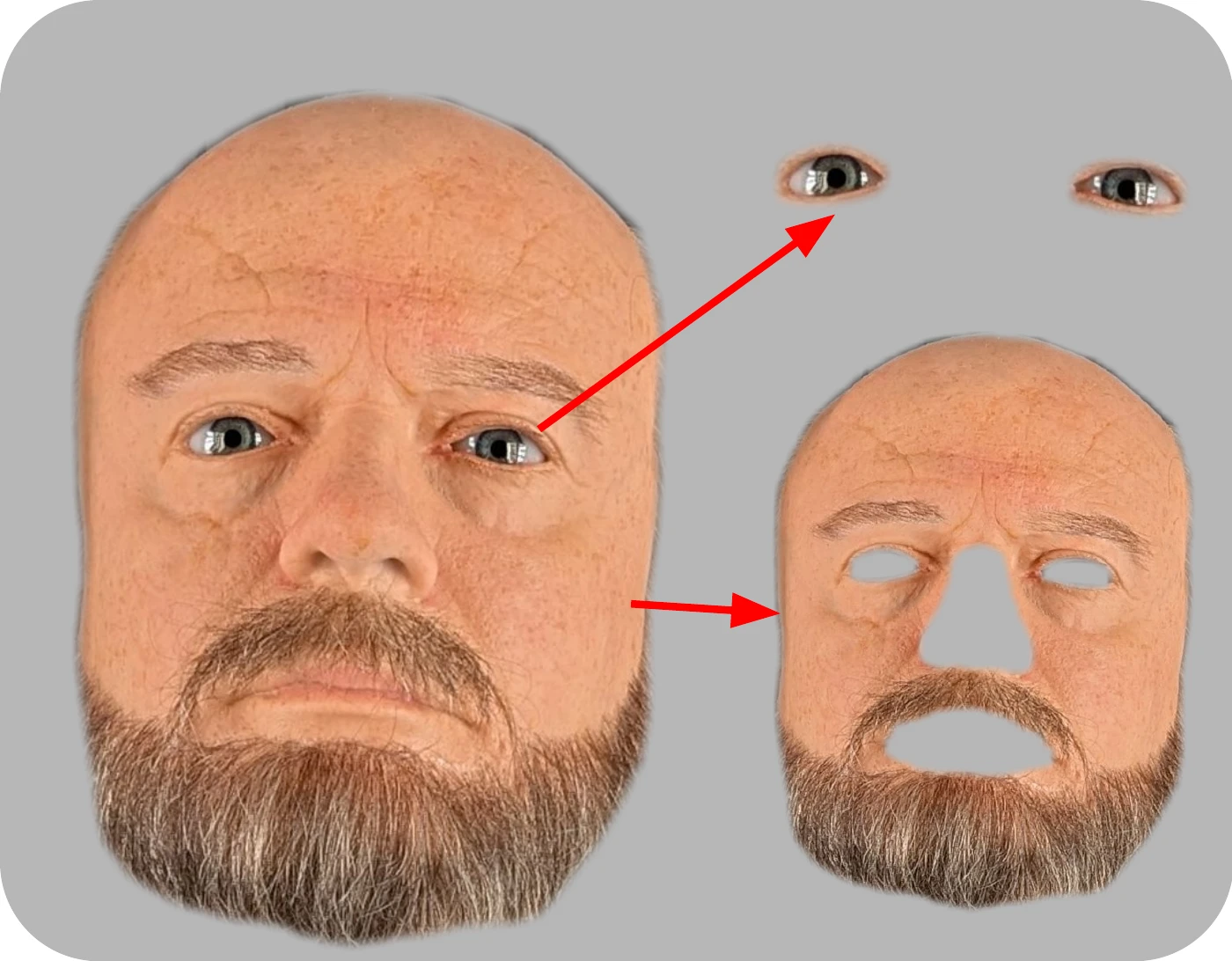
Eye contrast measures the separation between dark and bright structures inside the eyes. A single Otsu threshold partitions lightness values from both eye masks into two classes.
Here, μbright and μdark are class means of L, the normalized CIELAB L* channel, within the merged left and right eye masks.
Micro-contrast measures fine skin texture while reducing the influence of broad shading. We extract texture in log-lightness space, measure its local energy, and compress strong responses before pooling over the skin.
Here, Ωs is the skin mask. The thresholds q10 and q90 are the 10th and 90th percentiles of Slocal within that mask. Averaging the retained responses gives Cmicro.
COMPUTATION AT A GLANCE
Isolate texture. Measure its visible strength.
Transform lightnessL is the CIELAB L* channel normalized to [0, 1]; ε is a small constant for numerical stability.
Measure local RMS energyN(x) is an 11 × 11 neighborhood around pixel x.
Apply perceptual compressionFinally, retain the central 80% of responses within the skin mask and average them.
02 / DATASET
Controlled captures. Human judgments.
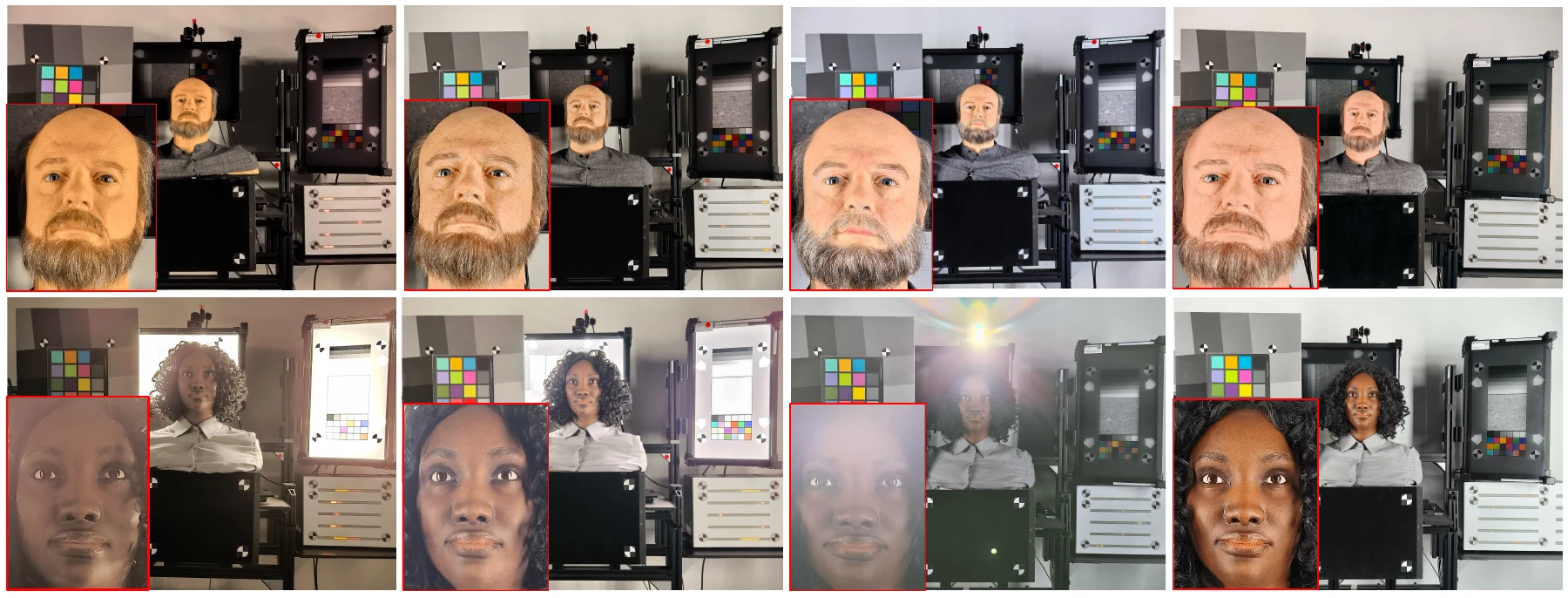
Two realistic mannequins, Eugene and Diana, let us compare rendering while keeping facial structure and surface texture fixed.
508
Full-resolution captures
29
Smartphones
2,400
Region-specific masks
20,000
Pairwise comparisons
5 lux100 lux1,000 lux10,000 lux
Four illumination levels and multiple backlight conditions (ΔEV = 0, 4, 7, 9).
Dedicated face, eye, and skin regions.
From a controlled scene to perceptual scores.
Original captures and contrast-adjusted variants form an 800-image annotation set. Trained image-quality experts completed four separate comparison tasks over 160 hours.
Pairwise judgments are converted to Just Objectionable Difference (JOD) scores. A difference of 1 JOD corresponds to a 75% choice probability for the higher-scoring image.
Dataset access A download link has not yet been added to this project page. See the project repository ↗ for available resources.
03 / RESULTS
Aligned with what people see.
Correlation with component-specific human judgments, without fitting the three contrast metrics to the annotations.
Component-wise agreement with human contrast judgments
Proposed measure
Within-lighting
Mixed-lighting
PLCC ↑
SRCC ↑
PLCC ↑
SRCC ↑
Overall contrast
0.792
0.780
0.688
0.693
Eye contrast
0.879
0.855
0.892
0.891
Micro-contrast
0.849
0.842
0.797
0.787
Within-lighting: device-disjoint evaluation on Groups 1–4. Mixed-lighting: evaluation on Group 5. Values reproduced from the main paper; see the paper for baselines and evaluation details.
BEYOND THE LAB
A first step toward real portraits.
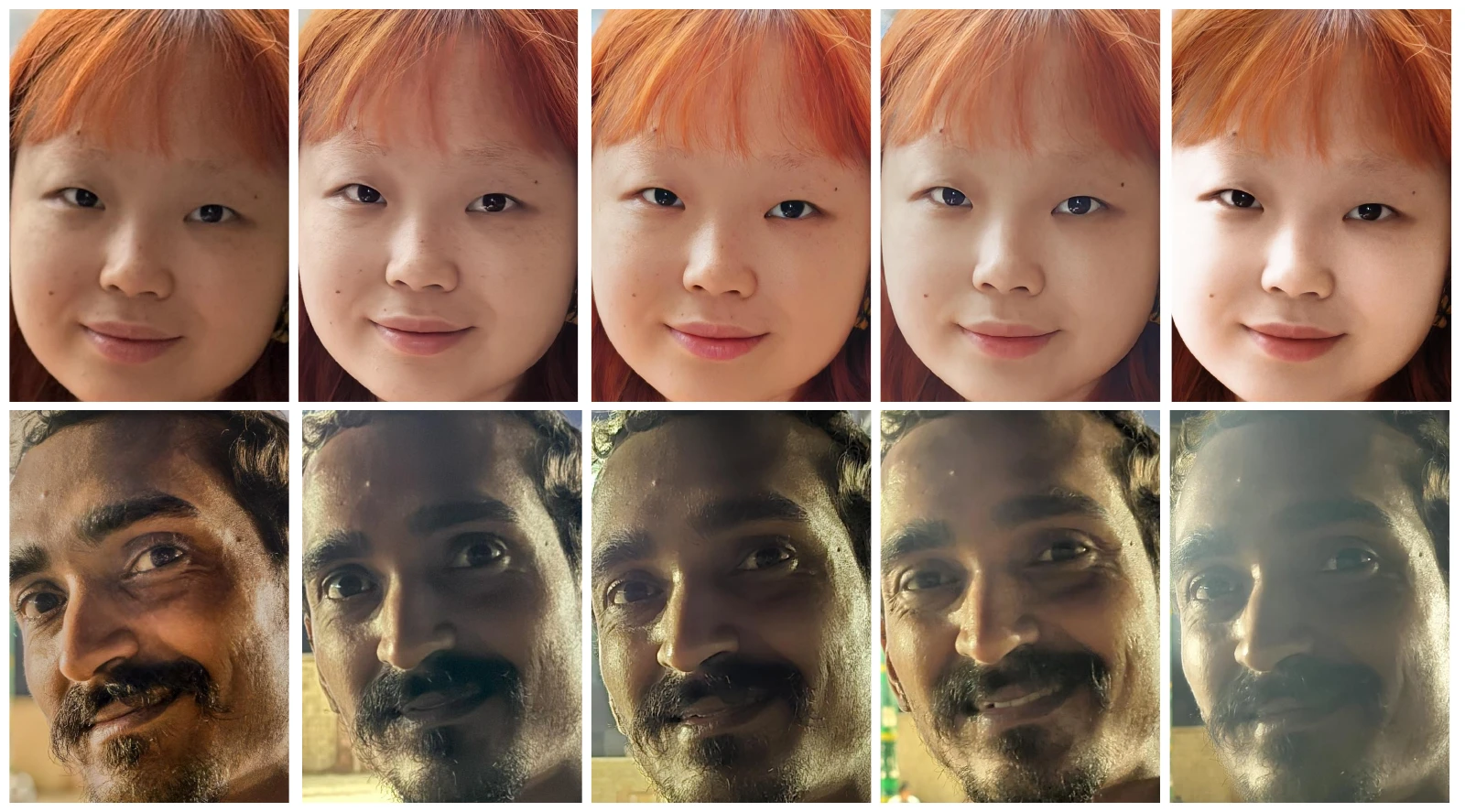
A preliminary evaluation uses 444 images across 10 subjects/scenes, with varied facial appearances, poses, and device processing.
The proposed zero-shot metrics achieve SRCC of 0.825 for overall contrast, 0.768 for eye contrast, and 0.731 for micro-contrast, macro-averaged across scenes.
Broader evaluation across identities, skin tones, poses, and capture conditions remains future work.
Examples from the preliminary real-portrait analysis.
@misc{cho2026facecontrast,
  title     = {Interpretable Face Contrast Modeling for
               Smartphone Portrait Rendering},
  author    = {Cho, Yujin and Pochon, Beno{\^i}t and
               Morel, Jean-Michel and Facciolo, Gabriele},
  year      = {2026},
  eprint    = {2610.26517},
  archivePrefix = {arXiv},
  primaryClass = {cs.CV},
  url       = {https://arxiv.org/abs/2610.26517}
}
Acknowledgements
This work was financed by ANRT grant N° 2023/0335 and used GENCI-IDRIS HPC and storage resources on Jean Zay under allocations AD011017622, AD011014895R2, AD011014895R1, and AD011014895R.